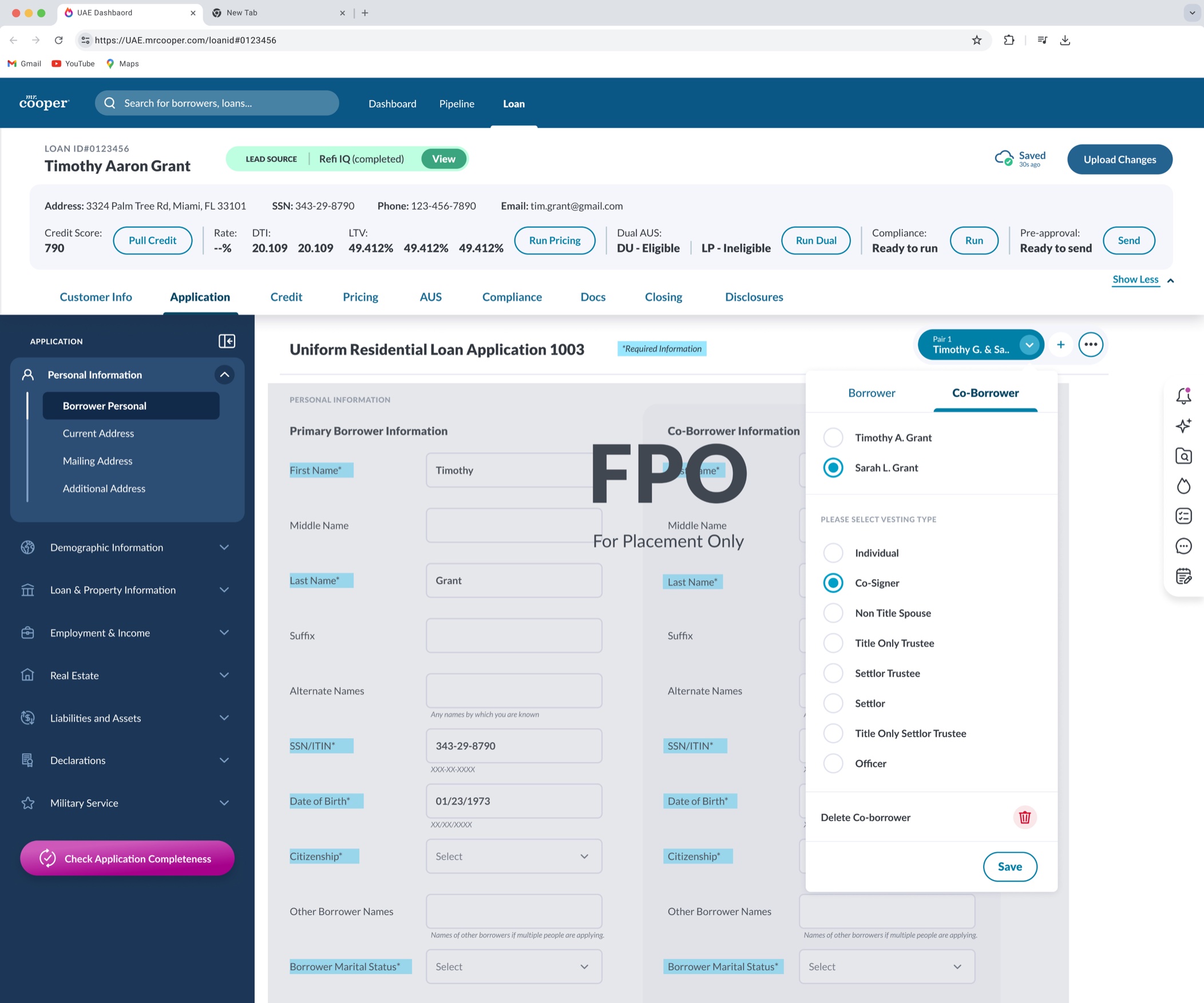
Digital 1003 mortgage application with co-borrower and vesting type panel
TL;DR

I led the design of a scalable Digital 1003 co-borrower experience that helped applicants and loan officers add, organize, and manage borrower pairs more clearly within the mortgage application flow.

The Problem

The existing borrower flow did not fully support the complexity of mortgage applications involving multiple borrowers. Loan officers and applicants needed a clearer way to add co-borrowers, organize borrower relationships, and manage borrower pairs without creating confusion or compliance risk.

The Details

Role: Senior UX Designer

Timeline: 3 months

Product: Digital 1003 Mortgage Application

Platform: Web (Internal Tool)

Impact / Efficiency

By simplifying complex multi-borrower workflows, the redesign supported a more efficient application experience. Post-launch reporting showed stronger application productivity, lock volume, and lead-to-lock conversion across the broader Origins platform.

A streamlined experience with measurable outcomes

The Managing Borrowers redesign reduced complexity within multi-borrower applications. Following the larger Origins rollout, operational reporting showed stronger application productivity, lock activity, and conversion across the lending funnel.

+58%

Lead-to-fund

+66%

Locks per day

+30%

Lead-to-lock

+55%

Applications/day

Discovery

understanding employee workflows, pain points, and technical needs to build tools that increase efficiency and adoption,

RESEARCH

Gathering Insights:

To understand the complexity of the feature, I reviewed the existing application flow, mapped borrower scenarios, and worked with product and mortgage stakeholders to identify key requirements. A major focus was understanding how borrower relationships needed to be represented both visually in the product and structurally in the application data.

Stakeholder and user interviews
Existing product audit
Mortgage application requirements
Loan officer workflow review
Compliance and AUS considerations
RESEARCH

Competitive Analysis:

To better understand how multi-borrower scenarios are handled across the mortgage application space, I reviewed Encompass, Blend, Zinc, and Bankrate. The goal was not to copy an existing pattern, but to identify how other platforms introduced borrower information, explained co-borrower responsibilities, and supported more complex application structures.

Encompass
Alameda Mortgage Corp
Bankrate
Zinc Solutions

UX Goals

Here is where I focused on progressive disclosure, clear hierarchy, and repeatable patterns.

UX GOALS

Goals That Guided the Redesign:

My goal was to improve the overall user experience by making the platform more intuitive, efficient, and scalable. I focused on creating clearer workflows, stronger visual hierarchy, and a structure that could better support future Digital 1003 needs.

  1. Make adding co-borrowers easier
  2. Clarify borrower relationships
  3. Reduce loan officer confusion
  4. Support compliance and AUS needs
  5. Create a scalable flow

Design Approach

Here is where I focused on progressive disclosure, clear hierarchy, and repeatable patterns.

UX APPROACH

Design Strategy:

During early exploration, I tested different ways to represent borrower relationships, including list-based structures, grouped cards, and step-based flows. The design needed to make complex borrower logic feel simple without hiding important details from loan officers.

Step 1: Mapped borrower flows from entry point to review

Step 2: Defined how co-borrowers would be added and grouped

Step 3: Designed borrower pair cards to improve visibility

Step 4: Created clear hierarchy between primary borrower, co-borrower, and pair details

Step 5: Reduced cognitive load by breaking complex borrower logic into manageable steps

Step 6: Partnered with product and engineering to validate edge cases

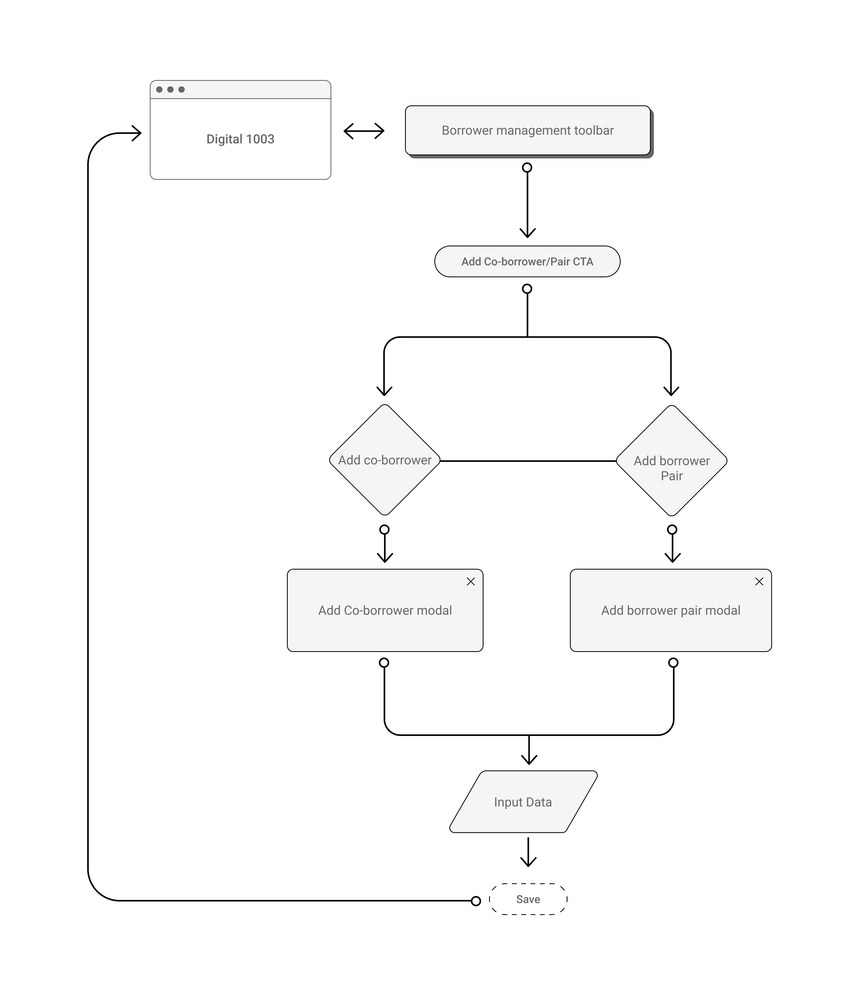
Digital 1003 borrower management sitemap from the Digital 1003 interface through add co-borrower and add borrower pair flows

Key User Scenarios

Single borrower adds one co-borrower

Peter Noel

Married couple applying together

Peter Noel

Multiple co-borrowers on one loan

Peter Noel

Two borrower pairs within the same application

Peter Noel

Loan officer reviews and edits borrower details

Peter Noel

Borrower information needs to flow into AUS/compliance systems

Peter Noel

Ideation

Here is where I focused on progressive disclosure, clear hierarchy, and repeatable patterns.

V.1
Cooper dashboard with stacked Adding Borrower Pair modal, pair selection, and vesting type panel
  • Makes borrower pairs more visible
  • Supports scalability
  • Good use of progressive disclosure
  • There are too many competing layers
  • Side panel may introduce cognitive overload
V.2
Manage Borrowers exploration with borrower pairs table and side-by-side borrower details
  • Familiar enterprise pattern
  • Clear separation of sections
  • Side-by-side comparison is helpful
  • Weak visual hierarchy
  • Feels heavy and overwhelming
V.3
Digital 1003 application with co-borrower vesting type selection inside the form context
  • The user stays in the form context
  • Less visual competition
  • The relationship is easier to understand
  • Stronger connection between action and outcome

Final Designs

Takeaways

Final thoughts and takeaways

The next phase would focus on validating the experience with loan officers and operations teams using realistic borrower scenarios. I would measure task completion, setup errors, and the time required to add co-borrowers, create borrower pairs, and assign vesting types. These findings would help identify opportunities to refine the workflow before expanding it across the broader digital 1003 application.

Next Steps

I would explore quick actions for editing or reorganizing borrower pairs. I would also introduce learning resources or tooltips to help new users understand vesting types and complex borrower structures without interrupting the primary workflow.